Hey fellow bloggers! I know this is a bit backwards, but I realized I never posted my preliminary bib or rhetorical analysis. So here is my preliminary bib and the analysis is soon to come!
Jeannina Perez
LIT 6009
Dr. Lisa Logan
26 February 2009
Preliminary Bibliography
The bulk of my research has been done via the online databases and the library catalog. The main database that I used was MLA international, but most of what I found is from library books. I would find one book in the catalog, but when I got to that section I would start to look around and end up finding more possible books. The keyword that worked the best was Deborah Sampson and Deborah Gannet (Deborah’s married name). I would like to find more on the representations of women, including images of lady liberty.
Database Keywords and Search Terms
- Sampson, Deborah
- The Female Review
- Mann, Herman
- Gannet, Deborah
- Female warrior
- Female soldier
- Cross-dressing and Early America
- Representations of Women and Columbia
- Representations of Women and Liberty
- Lady Liberty
- Women and Revolutionary Era
List of Databases
- MLA International
- UCF Catalogue
- GenderWatch
- American Periodicals
- Evans
- JSTOR
- History Research Center
- Wolrdcat
Bibliography
Eldridge, Larry D., ed. Women and Freedom. New York: New York UP, 1997.
Ellet, E. F. Revolutionary women in the War for American Independence a one-volume revised edition of Elizabeth Ellet's 1848 landmark series. Westport, Conn: Praeger, 1998
Greenhill, Pauline. ""Neither a Man nor a Maid": Sexualities and Gendered Meanings in Cross-Dressing Ballads." The Journal of American Folklore 108 (1995): 156-77.
Hiltner, Judith R. "Like Bewildered Star: Deborah Sampson, Herman Mann, and Address with Applause." Rhetoric Society Quaterly 29 (1999): 5-24.
Hiltner, Judith R. "She Bled in Secret: Deborah Sampson, Herman Mann and The Female Review." Early American Literature 34 (1999): 190-220.
Logan, Lisa M. "Columbia's Daughter in Drag: or, Cross-Dressing, Collaboration, and Authorship in Early American Novels." Feminist Interventions in Early American Studies. Ed. Mary C. Carruth. Tuscaloosa: University of Alabama P, 2006. 240-52.
Norton, Mary Beth. Liberty's daughters the revolutionary experience of American women, 1750-1800 : with a new preface. Ithaca, N.Y: Cornell UP, 1996.
Opdycke, Sandra. The Routledge Historical Atlas of Women in America. New York: Routledge, 2000.
Purcell, Sarah J. Sealed with blood war, sacrifice, and memory in Revolutionary America. Philadelphia: University of Pennsylvania P, 2002.
Weyler, Karen A. "An Actor in the Dram of Revolution: Deborah Sampson, Print, and Performance in the Creation of Celebrity." Feminist Interventions in Early American Studies. Ed. Mary C. Carruth. Tuscaloosa: University of Alabama P, 2006. 181-93.
Wiesner-Hanks, Merry, and Merry E. Wiesner. Gender in History (New Perspectives on the Past). New York: Blackwell, 2001.
Monday, March 23, 2009

Monday, March 9, 2009
Paper Proposal
Hey Everyone! When visiting the Coral Castle today I realized really randomly that I never posted my proposal here last week. So here it is!
Jeannina Perez
Literary Genres
Dr. Logan
3 March 2009
Nature’s Daughter: Gendered Nature to Identify Femininity in
Herman Mann’s The Female Review
Ecofeminist literary criticism seeks to expose symbolic connections “between gender, race, class, and representations of nature in literature” (Legler 228) in order to develop a discourse free of the simultaneous oppression of both women and nature. The use of nature in Herman Mann’s The Female Review operates to sustain Deborah Sampson’s femininity to justify her masquerade as a man in the military. However, Mann’s descriptions of nature are contradictory when nature is given an active role, showing the realms of freedom available through Sampson’s cross-dressing that are otherwise veiled.
Mann points confidently to Sampson’s apparent innate relationship with nature: “It is with peculiar pleasure, I here find occasion to speak of Miss Sampson’s taste for the study of Nature, or Natural Philosophy” (Mann 39). Throughout the text “idealised descriptions” (Gifford 1) of nature exist in relation to feminine roles of domesticity. While Sampson is acting the “masculine” role fighting in the army the text is primarily devoid of nature. Nature makes appearances in the text to sustain and idealize femininity, forcing nature into a passive role of “mirror” (Legler 229) for the women in the text. The mirroring descriptions of femininity function to support the overall focus on Sampson’s femaleness; femininity the narrative must focus on in order to eliminate Sampson’s actions as a threat to masculine social orders of behavior. As a result, Mann uses the amalgamation of nature and femaleness to justify Sampson’s actions.
However, despite Mann’s continual attempts to dissuade blurred gender roles, by displaying nature as an active bodied self amidst the disruption of gender, the narrative redefines femininity. While most of the text represents nature as the passive romanticized pastoral, nature becomes an active bodied self when Sampson does not. By placing nature in an active role, the narrative shows female freedom from blurring gender roles that cannot be shown when describing Sampson. In revealing the supporting and disruption of gendered constructions in nature, this exposes the process of “embodying nature” in the narrative. The contradictory descriptions in Mann’s narrative write nature out of passivity and into activity. By focusing on Sampson’s cross-dressing, scholars have overlooked the use of pastoral to simultaneously sustain and disrupt constructions of femininity.
Works Cited:
Gifford, Terry. Pastoral. New York: Routledge, 1999.
Legler, Karen, ed. Ecofeminism: Women, Culture, Nature. New York: Indiana University, Folklore Institute, 1997.
Jeannina Perez
Literary Genres
Dr. Logan
3 March 2009
Nature’s Daughter: Gendered Nature to Identify Femininity in
Herman Mann’s The Female Review
Ecofeminist literary criticism seeks to expose symbolic connections “between gender, race, class, and representations of nature in literature” (Legler 228) in order to develop a discourse free of the simultaneous oppression of both women and nature. The use of nature in Herman Mann’s The Female Review operates to sustain Deborah Sampson’s femininity to justify her masquerade as a man in the military. However, Mann’s descriptions of nature are contradictory when nature is given an active role, showing the realms of freedom available through Sampson’s cross-dressing that are otherwise veiled.
Mann points confidently to Sampson’s apparent innate relationship with nature: “It is with peculiar pleasure, I here find occasion to speak of Miss Sampson’s taste for the study of Nature, or Natural Philosophy” (Mann 39). Throughout the text “idealised descriptions” (Gifford 1) of nature exist in relation to feminine roles of domesticity. While Sampson is acting the “masculine” role fighting in the army the text is primarily devoid of nature. Nature makes appearances in the text to sustain and idealize femininity, forcing nature into a passive role of “mirror” (Legler 229) for the women in the text. The mirroring descriptions of femininity function to support the overall focus on Sampson’s femaleness; femininity the narrative must focus on in order to eliminate Sampson’s actions as a threat to masculine social orders of behavior. As a result, Mann uses the amalgamation of nature and femaleness to justify Sampson’s actions.
However, despite Mann’s continual attempts to dissuade blurred gender roles, by displaying nature as an active bodied self amidst the disruption of gender, the narrative redefines femininity. While most of the text represents nature as the passive romanticized pastoral, nature becomes an active bodied self when Sampson does not. By placing nature in an active role, the narrative shows female freedom from blurring gender roles that cannot be shown when describing Sampson. In revealing the supporting and disruption of gendered constructions in nature, this exposes the process of “embodying nature” in the narrative. The contradictory descriptions in Mann’s narrative write nature out of passivity and into activity. By focusing on Sampson’s cross-dressing, scholars have overlooked the use of pastoral to simultaneously sustain and disrupt constructions of femininity.
Works Cited:
Gifford, Terry. Pastoral. New York: Routledge, 1999.
Legler, Karen, ed. Ecofeminism: Women, Culture, Nature. New York: Indiana University, Folklore Institute, 1997.
Monday, March 2, 2009
Monday Rant
I have a stray pigeon that has been keeping me from focusing, so I am going to use this space to rant about it so I can move on.
After reading Weyler’s article "An Actor in the Drama of Revolution: Deborah Sampson, Print, and Performance in the Creation of Celebrity,” I could not stop thinking about how Sampson’s public persona reminds me of Disney’s manipulation of Mulan. Weyler describes how Sampson’s bending of heteronormative gender roles is only acceptable for the sake of patriotic duty. Once her patriotic is completed, she must return to unambiguous heteronormative behavior. Blurring the lines of gender is acceptable only if present to help a cause.
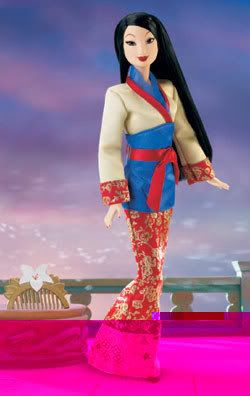
When reading this, I immediately connected it to Disney’s adaptation of Mulan. Despite being dressed like a man for most of the film, all Mulan merchandise after release of the film represents her as a “feminine” princess. She is rarely again represented cross-dressing, but instead as an eroticized geisha. The film also ends with a feminine heteronormative version of Mulan. After Mulan has saved China, the emperor offers her an honored position as one of his advisers. While a woman has never been given this honor before, Mulan rejects the offer. She instead goes back to her home to re-attain her role as daughter. The film also reinstates the gender norms it initially sought to break. Mulan fulfills her expectations as a woman, and marries instead of continuing as a political androgynous force.
It is amazing to me that this still occurs. Just a Sampson’s performance is only acceptable for a patriotic purpose, so is the case with Disney’s representation of Mulan. She is only empowered by cross-dressing if it serves a patriotic purpose. Even now, cross-dressing has to be justified so a community may feel comfortable about it. I just thought this was really fun to think about and now I can move on. :)


After reading Weyler’s article "An Actor in the Drama of Revolution: Deborah Sampson, Print, and Performance in the Creation of Celebrity,” I could not stop thinking about how Sampson’s public persona reminds me of Disney’s manipulation of Mulan. Weyler describes how Sampson’s bending of heteronormative gender roles is only acceptable for the sake of patriotic duty. Once her patriotic is completed, she must return to unambiguous heteronormative behavior. Blurring the lines of gender is acceptable only if present to help a cause.
When reading this, I immediately connected it to Disney’s adaptation of Mulan. Despite being dressed like a man for most of the film, all Mulan merchandise after release of the film represents her as a “feminine” princess. She is rarely again represented cross-dressing, but instead as an eroticized geisha. The film also ends with a feminine heteronormative version of Mulan. After Mulan has saved China, the emperor offers her an honored position as one of his advisers. While a woman has never been given this honor before, Mulan rejects the offer. She instead goes back to her home to re-attain her role as daughter. The film also reinstates the gender norms it initially sought to break. Mulan fulfills her expectations as a woman, and marries instead of continuing as a political androgynous force.
It is amazing to me that this still occurs. Just a Sampson’s performance is only acceptable for a patriotic purpose, so is the case with Disney’s representation of Mulan. She is only empowered by cross-dressing if it serves a patriotic purpose. Even now, cross-dressing has to be justified so a community may feel comfortable about it. I just thought this was really fun to think about and now I can move on. :)

Thursday, February 26, 2009
Weyler Article Abstract
Jeannina Perez
Dr. Logan
23 February 2009
Weyler, Karen A. "An Actor in the Drama of Revolution: Deborah Sampson, Print, and Performance in the Creation of Celebrity." Feminist Interventions in Early American Studies. Ed. Mary C. Carruth. New York: University of Alabama P, 2006. 183-93.
Weyler’s chapter, included in Feminist Interventions in Early American Studies, explores how Deborah Sampson was “successful in her masquerade” (184) and gained public support despite her disruption of gender norms. Weyler frames this discussion by beginning with three accounts of women that cross-dressed as male soldiers in the American Revolution. Other female impersonating officers, Ann Bailey and an anonymous woman, faced severe punishment and denunciation for deviating from traditional female roles. As a result, Weyler questions how Sampson’s experience could be so dissimilar from the experience of these two women.
Weyler outlines four main factors she attributes to Sampson’s success and popularity. The four sections are retaining the image chastity, allowing men to speak for her publicly, awareness of gender performaty, and understanding the importance of print culture.
The preservation of chastity occurs in connection with Sampson’s understanding of gender roles. According to Weyler, Sampson’s cross-dressing is elevated as a patriotic gesture. By making her “masquerade,” a patriotic gesture Sampson’s asserts culturally that her actions are not an attempt to emasculate white men, making her actions acceptable. Weyler also connects cross-dressing to theatrics, the American Revolution posing as the main stage. Under this understanding of theater, Sampson acts like the masculine soldier only to return to traditional feminine attire and behavior upon completing her patriotic duty. The use of male voice and influence is another tool Weyler outlines. Sampson approaches both Freneau and Mann, influential male voices, to speak for her cause. Sampson understood that is these men spoke well of her actions that it would be more acceptable.
One of the elements that most interested me in Weyler’s article was Sampson as “a humanized version of the chaste goddesses Liberty and Columbia” (188). Weyler argues that this tactic was part of Sampson’s understanding of print culture. Print makes possible the exaggeration of Sampson’s chastity to a celestial level. Weyler points out that Mann goes as far as to call her the “orphaned daughter of Columbia” (189).
Weyler text also addresses the economic reasons behind Sampson’s actions. Upon being discovered, Sampson seemed “uninterested in capitalizing on her renown” (186). Economic hardships are what drive Sampson to seek compensation from the military. It is this search for compensation that leads to Mann’s text and Sampson’s speaking tour. Overall Weyler’s essay was illuminating. It has given me a lot of novel ideas for research and has helped me better understand the implications of Mann’s involvement.
Dr. Logan
23 February 2009
Weyler, Karen A. "An Actor in the Drama of Revolution: Deborah Sampson, Print, and Performance in the Creation of Celebrity." Feminist Interventions in Early American Studies. Ed. Mary C. Carruth. New York: University of Alabama P, 2006. 183-93.
Weyler’s chapter, included in Feminist Interventions in Early American Studies, explores how Deborah Sampson was “successful in her masquerade” (184) and gained public support despite her disruption of gender norms. Weyler frames this discussion by beginning with three accounts of women that cross-dressed as male soldiers in the American Revolution. Other female impersonating officers, Ann Bailey and an anonymous woman, faced severe punishment and denunciation for deviating from traditional female roles. As a result, Weyler questions how Sampson’s experience could be so dissimilar from the experience of these two women.
Weyler outlines four main factors she attributes to Sampson’s success and popularity. The four sections are retaining the image chastity, allowing men to speak for her publicly, awareness of gender performaty, and understanding the importance of print culture.
The preservation of chastity occurs in connection with Sampson’s understanding of gender roles. According to Weyler, Sampson’s cross-dressing is elevated as a patriotic gesture. By making her “masquerade,” a patriotic gesture Sampson’s asserts culturally that her actions are not an attempt to emasculate white men, making her actions acceptable. Weyler also connects cross-dressing to theatrics, the American Revolution posing as the main stage. Under this understanding of theater, Sampson acts like the masculine soldier only to return to traditional feminine attire and behavior upon completing her patriotic duty. The use of male voice and influence is another tool Weyler outlines. Sampson approaches both Freneau and Mann, influential male voices, to speak for her cause. Sampson understood that is these men spoke well of her actions that it would be more acceptable.
One of the elements that most interested me in Weyler’s article was Sampson as “a humanized version of the chaste goddesses Liberty and Columbia” (188). Weyler argues that this tactic was part of Sampson’s understanding of print culture. Print makes possible the exaggeration of Sampson’s chastity to a celestial level. Weyler points out that Mann goes as far as to call her the “orphaned daughter of Columbia” (189).
Weyler text also addresses the economic reasons behind Sampson’s actions. Upon being discovered, Sampson seemed “uninterested in capitalizing on her renown” (186). Economic hardships are what drive Sampson to seek compensation from the military. It is this search for compensation that leads to Mann’s text and Sampson’s speaking tour. Overall Weyler’s essay was illuminating. It has given me a lot of novel ideas for research and has helped me better understand the implications of Mann’s involvement.
Thursday, February 5, 2009
Trouble getting the book...

I have been having trouble finding a modern version of this book for my research project. After hours of anger at the lack of publishing of this awesome text, I decided to periodically print out copies of the original text from the Evans database. I was not looking forward to it, but having been told the rule about the weird “s” I thought I could handle it. I was surprised how easily I adapted to reading the original text. Some parts are faded because it’s a copy, but overall I had a lot of fun reading the first chapter. The difference in printing type almost made me have to pay closer attention to the reading. When I took a Shakepeare class as an undergrad, my professor always brought copies of old texts to read to the class. I always found them really intimidating, so it was really pleasant to get out of my comfort zone here and then conquer the crazy S!
Monday, January 26, 2009
Various Pictoral Representations of Deborah Samson
Different Faces of DS!

www.historycooperative.org

www.gardenofpraise.com

www.myhero.com

www.libertykids.com

www.historycooperative.org

www.gardenofpraise.com

www.myhero.com

www.libertykids.com
Completing the Artifact Inventory
Beginning info on Herman Mann’s
Question: When, where, and by whom was your text first printed?
Question: How often was your text reprinted? List all of the reprints using MLA citation style. Do not confuse dates of publisher’s/printer’s birth and death with reprint dates.
Answesr: According to Worldcat and the National Union Catalog, it was reprinted four times.
- Mann, Herman. The female review. Life of Deborah Sampson, the female soldier in the war of the revolution. 2nd ed.
- Mann, Herman. The female review. Life of Deborah Sampson, the female soldier in the war of the revolution. 2nd ed.
- Mann, Herman. The Female Review : Life of Deborah Sampson, the Female Soldier in the War of the Revolution.
- Mann, Herman. The Female Review Life of Deborah Sampson, the Female Soldier in the War of the Revolution.
Blog Thoughts: I was surprised at how few printings exist of this text. Davidson just made it sound so delicious that I expected it to be a relatively popular text. Davidson though does talk about the low number of subscriptions The Female Review had comparably to other earlier texts like Charlotte Temple. It is likely that because of low subscription that printers didn’t believe they could make a profit out of the text. This may have also be a text that was not well received to an extent because of its themes.
Question: What was the actual size of your novel in inches or centimeters? (That is, consider it as a material object.) What information can you find about its physical presence? Do you think it was expensive or inexpensive?
Answer: The actual size of the text is 17cm. According to the Evans database, the original text is leather bound with “intaglio” prints.
Blog Thoughts: When researching these aspects of the text I found myself wishing I could the actual original text. The opportunity to study this text digitally is an amazing testament to evolving scholarship but I cannot help but wonder what I am missing in some ways by not being able to see the actual physical book.
Question: View the original title page using the digital database or microfilm. What is included there?
Answer: The original title page has a portrait of Deborah Sampson (the main character) in an oval mirror that is embellished with an eagle and swords. It also has the name Deborah Sampson under the portrait. Under the name is written who the text was published by, but the name is difficult to read.
Blog Thoughts: I was so intrigued by the militant images surrounding the portrait of Deborah. While she did dress like a man to participate in the military, I still expected a highly feminine visual representation. Once I read the book, it may be clearer. It makes me think about the Disney representations of Mulan. Despite being a powerful woman that goes into the military by cross-dressing Disney always represents her as highly feminine.
Question: What miscellaneous front matter exists?
Answer: After the title page there is a page that has the complete title of the novel and a brief description of the text. Following the textual description, there is an explanation of the appendix followed by the printing information.
Blog Thoughts: The thing that most stood out to me in these first couple of pages was how long the title was. The title morphs into a description of the actual text. It also almost sounds like a sales pitch to me when read aloud. It reminds me of modern books descriptions that we find at the back of our books. It’s just enough information to get the reader interested in the text. It’s interesting to see how those tools to allure readers still exist in different manifestations.
Subscribe to:
Posts (Atom)

